
Article by Dimitra Founda (Research Director, Institute for Environmental Research and Sustainable Development, National Observatory of Athens)
During the night of 14 October and into the early hours of 15 October 1852, Athens was literally shaken by an exceptionally violent storm that devastated the small city of the time and left a deep mark on the memory of its inhabitants. The dates refer to the Julian calendar, which was in use at the time, and correspond to 26–27 October in the Gregorian calendar used nowadays.
In his book The Climate of Greece, Dimitrios Aeginítis refers to this weather phenomenon and classifies it as a laelaps (a word to describe a storm, strong winds accompanied by rain, or a tornado). Such storms are characterised by winds blowing at speeds exceeding 100 km/h. The term originates from Greek mythology, where Laelaps (Λαίλαψ) was the dog created by Hephaestus for Zeus, renowned for its extraordinary speed and ferocity.
The violent storm erupted on the evening of 14 October with unprecedented fury, terrifying the city’s inhabitants, who shut themselves inside their homes and waited for the phenomenon to subside. The wind blew from the south, as Dimitrios Aeginítis reports, with such a force that it uprooted tall trees, devastated the Royal Garden, brought down houses and bridges, tore off roofs, and ripped up stone paving slabs and the city’s street lamps. The violent southerly winds also battered the port of Piraeus mercilessly, sweeping away, destroying and sinking ships, including the Greek corvette Queen Amalia, one of the finest vessels of its time. Some grain-carrying ships were destroyed, leaving tonnes of wheat floating in the harbour and creating an extraordinary scene.
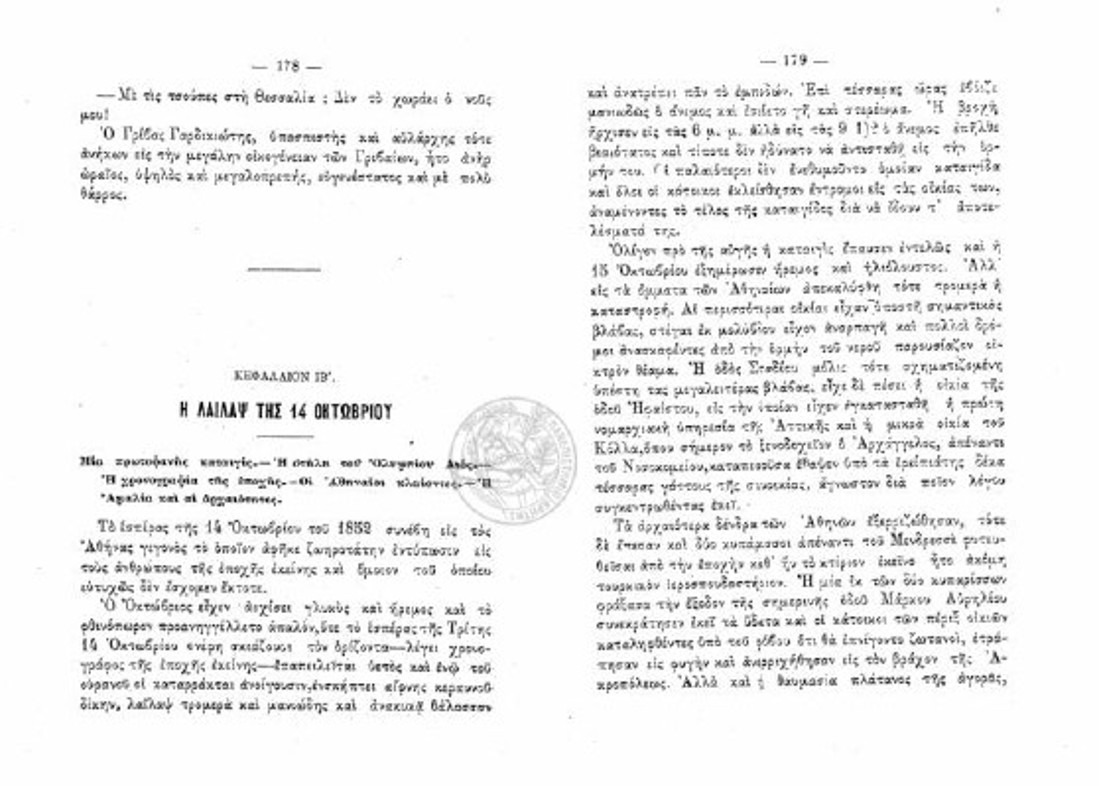
A detailed account of the destruction caused by the storm is also included in G. V. Tsokopoulos’s book Old Athens – Queen Amalia, in which the author devotes a separate chapter to the event (Figure 1). As if this was not enough, two earthquakes that struck during the night added to the terrifying scene, plunging the already frightened inhabitants into even greater panic as they felt they were living a nightmare.
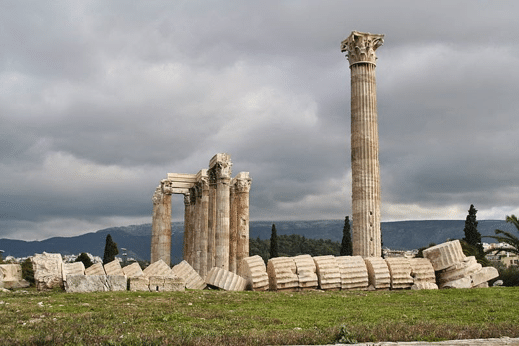
Shortly before dawn on 15 October, the storm subsided. The following morning was calm and sunny, and the inhabitants emerged from their homes to confront the scale of the devastation. They were astonished by a horrifying sight: one of the 16 columns of the Temple of Olympian Zeus (the Olympieion) that had survived until then lay shattered on the ground. The temple is built of Pentelic marble, and its Corinthian columns stand 17 metres tall, measure 2.6 metres in diameter and weigh 364 tonnes each.
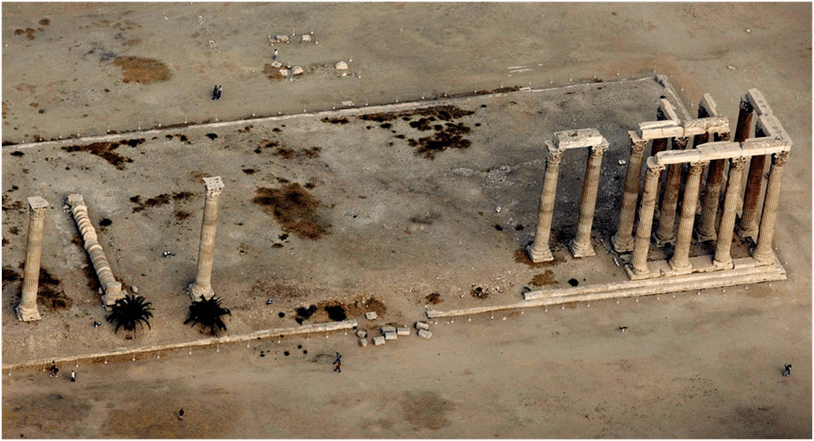
The storm was so violent that it toppled the middle column of the three most isolated columns of the temple, breaking it into 18 enormous drums (Figures 2 and 3). The position and orientation of the fallen column confirm that south-easterly winds prevailed, as Aeginítis reports as well. In addition to the column at the Olympieion, Tsokopoulos mentions that two columns of the Erechtheion also fell.
News spread quickly, and the city’s inhabitants gathered around the fallen column, mourning the loss, which was described as a “national disaster”. The following excerpt from the newspaper “Αιών” (“Centruy”), published on 15 October 1852, is particularly characteristic:
“…But the most grievous disaster of all was the collapse, in a straight line, of one colossal column of the Temple of Olympian Zeus. We saw this giant, standing for twenty-two centuries, lying face down, bearing eighteen enormous drums, and we felt the power of God, acting either through nature or through divine providence… This column was the middle one of the three columns standing apart from the main group of columns at the Temple of Olympian Zeus…”
Beyond the grief, the fall of the column instilled another fear in the people of Athens, who recalled an older prophecy. According to the story, a monk known as a stylite, who had lived for years atop the columns, had predicted that if one of them ever fell, a great calamity would befall the city. Many who believed the prophecy were terrified by what had happened, and priests hurried to the site to pray and ward off the impending evil.
In the years that followed, every calamity and misfortune, including Queen Amalia’s inability to have children, was attributed to the bad luck brought by the fallen column. Even the deadly cholera epidemic that broke out in Athens two years later, in 1854, was linked to the prophecy by the city’s inhabitants. The epidemic had been introduced by French and British forces that occupied the port of Piraeus.
The extraordinary violence of the 14 October storm and the destruction it caused had such a profound impact on the local community that, for years afterwards, the inhabitants used the expression “the weather of the column” whenever they wanted to describe exceptionally severe weather.
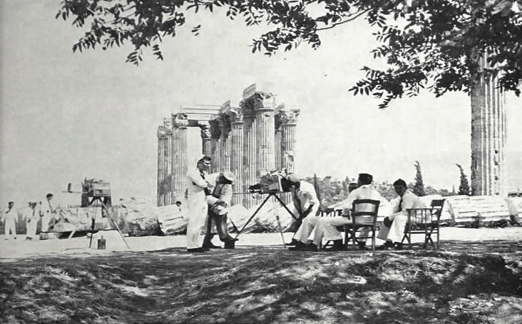
Despite their initial fear, the people of Athens soon grew accustomed to the sight of the fallen column, which became a local attraction. They walked and posed for photographs on it, while the owners of nearby cafés set up tables at the site to offer their customers a better view (Figure 3).
In the period that followed, heated discussions and disagreements took place in the Greek Parliament over whether the fallen column should be raised. Queen Amalia eventually consulted the Greek Archaeological Service to ask whether the column should be restored to its original position. Archaeologists Kyriakos Pittakis and Alexandros Rizos Rangavis advised her that it would be better to leave the column as it was.
Indeed, the column was never moved and remains to this day exactly where it fell during the violent storm of 14 October 1852, still perfectly aligned. It stands as a historical landmark for visitors to the archaeological site (Figure 4).
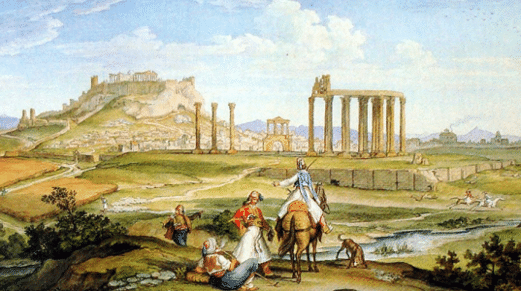
Ilissos 1833 / © Johann MIchael Wittme
Sources:
Dimitrios Aeginítis, The Climate of Greece, Part I: The Climate of Athens, Athens, 1907.
G. V. Tsokopoulos, Old Athens – Queen Amalia, Athens, 1905 (published by P. C. Chaidopoulos).
https://pireorama.blogspot.com/2015/03/1852.html